
 6 months ago
66
6 months ago
66
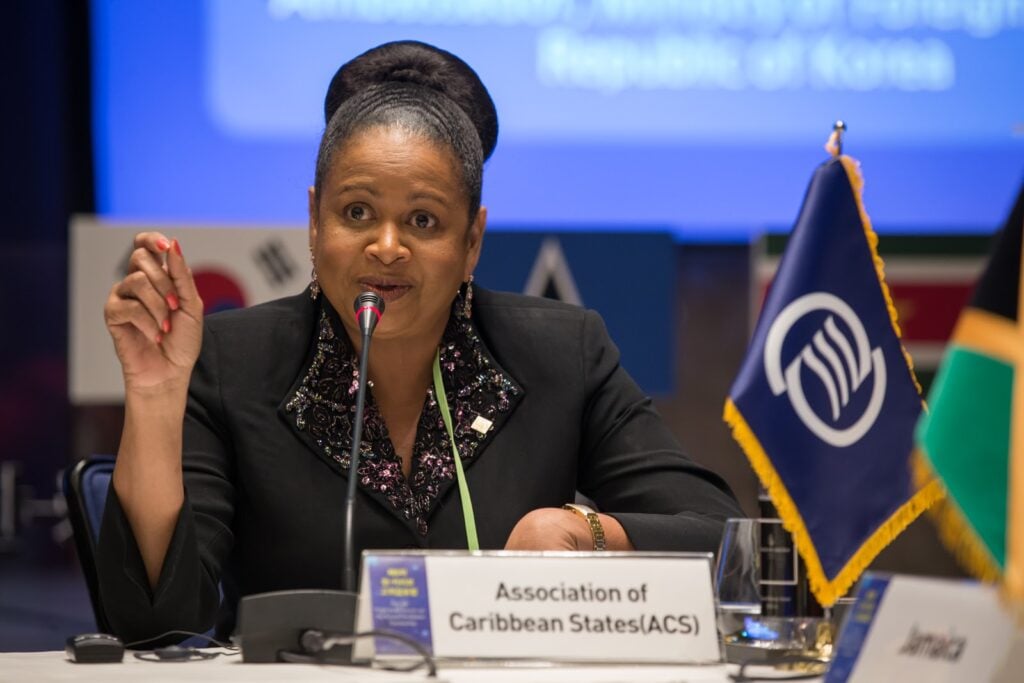
The former chair of the United Nations Permanent Forum on People of African Descent, June Soomer, is urging Caribbean governments to intensify their push for reparatory justice, arguing that sustainable development in the region cannot occur without confronting the legacies of slavery and colonialism.
Soomer made the call while speaking at the launch of the Second International Decade for People of African Descent at the University of The Bahamas over the weekend. The event included a symposium on Haitian restitution and reparatory justice.
“Reparatory justice is not a recent movement,” Soomer said. “It started on the African coast when we were enslaved and put into dungeons before we were shipped across and trafficked to the Americas.”

The St. Lucian-born diplomat, who previously served as secretary general of the Association of Caribbean States, said the Caribbean has played a leading role in advancing the global reparations movement.
She noted that the regional push gained renewed momentum in 2013 when leaders of the Caribbean Community agreed to pursue reparatory justice for Indigenous peoples and people of African descent.
Soomer said the CARICOM Reparations Commission first acknowledged the genocide of Indigenous peoples before addressing crimes committed against Africans who were enslaved and transported to the Americas.
“It is important that we never forget what the Indigenous people went through first,” she said. “Genocide and ethnic cleansing have made them invisible in plain sight.”
She also stressed the importance of reframing how slavery is discussed historically.
“We were not slaves. We were human beings who were enslaved,” Soomer said. “We were not born slaves. We were human beings. We were lawyers, doctors, teachers.”
Rejecting the notion that Africans passively accepted enslavement, Soomer said resistance occurred both on the African continent and throughout the colonial era.
“Not only did we resist in Africa, we fought many colonial wars so that we would not be shipped across,” she said, adding that the second UN decade must move beyond symbolic recognition to focus on structural reforms, including education changes and legal reviews in Caribbean countries.
Soomer also urged governments to expand the reparations conversation to include environmental injustice, climate change and technological bias, arguing that Caribbean communities remain disproportionately vulnerable to environmental damage despite contributing little to global emissions.
“All of the greenhouse gases are now coming back and affecting us,” she said. “It is a double reparations we want because they left us to live on marginalised lands — on the slopes of mountains, on river banks, or in places where the sea can come and wipe out a whole island.”
She pointed to the devastation caused by Hurricane Dorian, which struck The Bahamas in 2019 as a Category 5 storm, as an example of the region’s vulnerability to climate impacts.
Soomer also called for Caribbean countries to review laws and constitutions inherited from colonial rule.
“We cannot continue to depend on colonial legislation that does not represent us,” she said. “We have to call for a review of all of our constitutions and legislation that not only continues to dehumanise us within the criminal justice system as a group, but continues to discriminate against us as women of African descent.”
She noted that the legal structure of slavery placed particular burdens on enslaved women, as the status of children born into slavery was determined through the mother.
“We think that when we talk about labour we are only talking about work in the field,” Soomer said. “We are also talking about labour and the forced impregnation of women of African descent. Capitalism was built on the wounds of Black women.”
Soomer also called for recognition of collective rights, arguing that the history of slavery and colonialism affected entire communities.
“We were collectively stolen. We were collectively criminalised. We were collectively beaten. And now we do not have collective rights,” she said. “Independence did not mean decolonisation.”
She also urged stronger collaboration between governments and civil society groups involved in the reparations movement, warning that without wider public participation the issue could lose momentum.
“We will be running globally with reparatory justice at a governmental level and we will not find our people running behind us because they do not know what we are running behind,” she said. “We must break the back of systemic racism.”
 English (US) ·