
 6 months ago
70
6 months ago
70
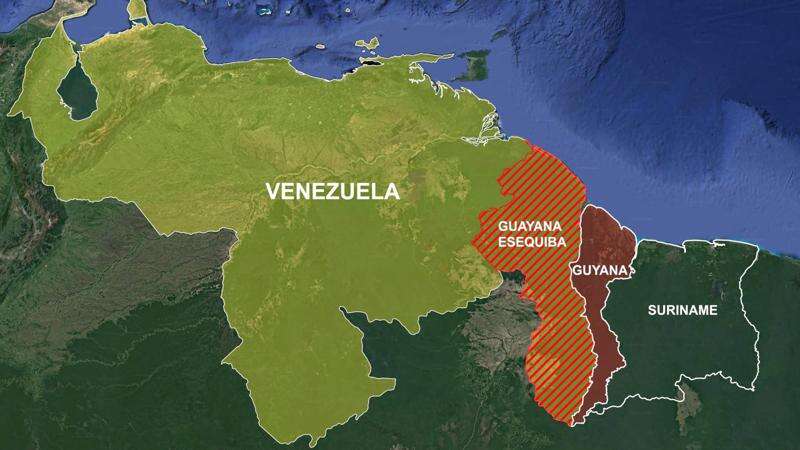
Guyana on Thursday said Venezuela has no legal authority over waters off the Essequibo Region, arguing that the land boundary between the two countries was settled in 1899 and that nothing prevents the South American nation from conducting a 3D seismic survey of a 25,000-square-kilometre offshore area or attracting investors there.
“The Ministry wishes to remind the Government of the Bolivarian Republic of Venezuela that the Government of Guyana has the authority to grant permission for any activities within the maritime areas appurtenant to the coastal territory of Guyana, as defined by the Arbitral Award of 1899, which established the frontier between British Guiana and Venezuela,” the foreign ministry said.
Guyana said the boundary between the two states was definitively settled more than a century ago by the 1899 Arbitral Award, which Venezuela accepted and benefited from at the time, providing legal certainty for both countries.

That award, Guyana said, brought finality to the territorial boundary and enabled both states to exercise the full rights and advantages arising from their respective territories and maritime projections.
“It is therefore particularly incongruous that Venezuela, having historically benefited from the stability and legal clarity afforded by that settlement, now seeks to challenge Guyana’s sovereign right to utilise and develop the resources contained within the territory and maritime areas that lawfully appertain to Guyana,” the government said.
On that basis, Guyana said it “respectfully rejects” Venezuela’s protest and also dismissed the claim that any portion of its maritime space or continental shelf belongs to the Bolivarian Republic of Venezuela.
The Guyanese government described Venezuela’s statement as “unfounded, inaccurate, and entirely inconsistent” with established principles of international law, including the assertion that the maritime boundary between the two countries had yet to be legally settled.
Georgetown maintained that it enjoys sovereignty up to 12 nautical miles in its territorial sea and sovereign rights beyond that distance in its exclusive economic zone (EEZ) and continental shelf.
According to the government, the maritime areas where the seismic survey will take place “lie unequivocally” within Guyana’s EEZ and continental shelf.
“These rights include the exclusive authority to explore, exploit, conserve and manage natural resources within its maritime jurisdiction. As such, Guyana’s decision to facilitate the acquisition of high-resolution seismic data through a 3D multi-client seismic survey represents a legitimate and lawful exercise of its rights and is entirely consistent with international law and established state practice,” the foreign ministry added.
The government said the seismic acquisition initiative is part of Guyana’s broader national strategy to improve scientific understanding of its offshore petroleum basin, enhance transparency in resource management, and increase the attractiveness of Guyana’s offshore acreage to responsible international investors.
Officials explained that the program will use advanced geophysical techniques to generate high-resolution subsurface imagery to support exploration planning and strengthen long-term governance of the country’s offshore energy sector.
Guyana also rejected Venezuela’s characterization that the activities are taking place in “undelimited maritime areas.”
“Such claims constitute a deliberate misrepresentation of both the geographic and legal realities governing Guyana’s maritime jurisdiction,” the government said.
Guyana added that it has consistently exercised peaceful administration and jurisdiction over its maritime spaces, including the licensing and regulation of offshore exploration activities, in line with international law and with due regard to the rights of other states.
The government also pointed to the Geneva Agreement of 1966, which governs the resolution of the dispute stemming from Venezuela’s claim — first made in 1962 — that the 1899 Arbitral Award is null and void.
According to Georgetown, the agreement does not prevent Guyana from pursuing economic development activities within its territory or adjacent maritime areas.
Responding to Venezuela’s warning that it would not recognize any concession, license or activity related to natural resource exploration in “undelimited maritime areas” granted unilaterally by Guyana, the government said international law does not allow one state to invalidate the lawful sovereign decisions of another within its territory or maritime zones.
Guyana said Venezuela’s statements amount to an attempt to interfere with its sovereign right to pursue economic development and manage natural resources for the benefit of its people.
“The Ministry therefore calls upon the Government of the Bolivarian Republic of Venezuela to refrain from issuing inflammatory and misleading statements that seek to undermine Guyana’s sovereign rights or discourage legitimate economic activity within Guyana’s maritime domain,” the statement said.
The area where the 3D seismic study will be conducted includes 11 blocks from Guyana’s 2022 licensing round located south of the Stabroek Block and extending to the Guyana-Suriname border.
The agreement also allows for the reprocessing and integration of existing seismic survey datasets across the three survey lots, the government said.
 English (US) ·