
 6 months ago
60
6 months ago
60
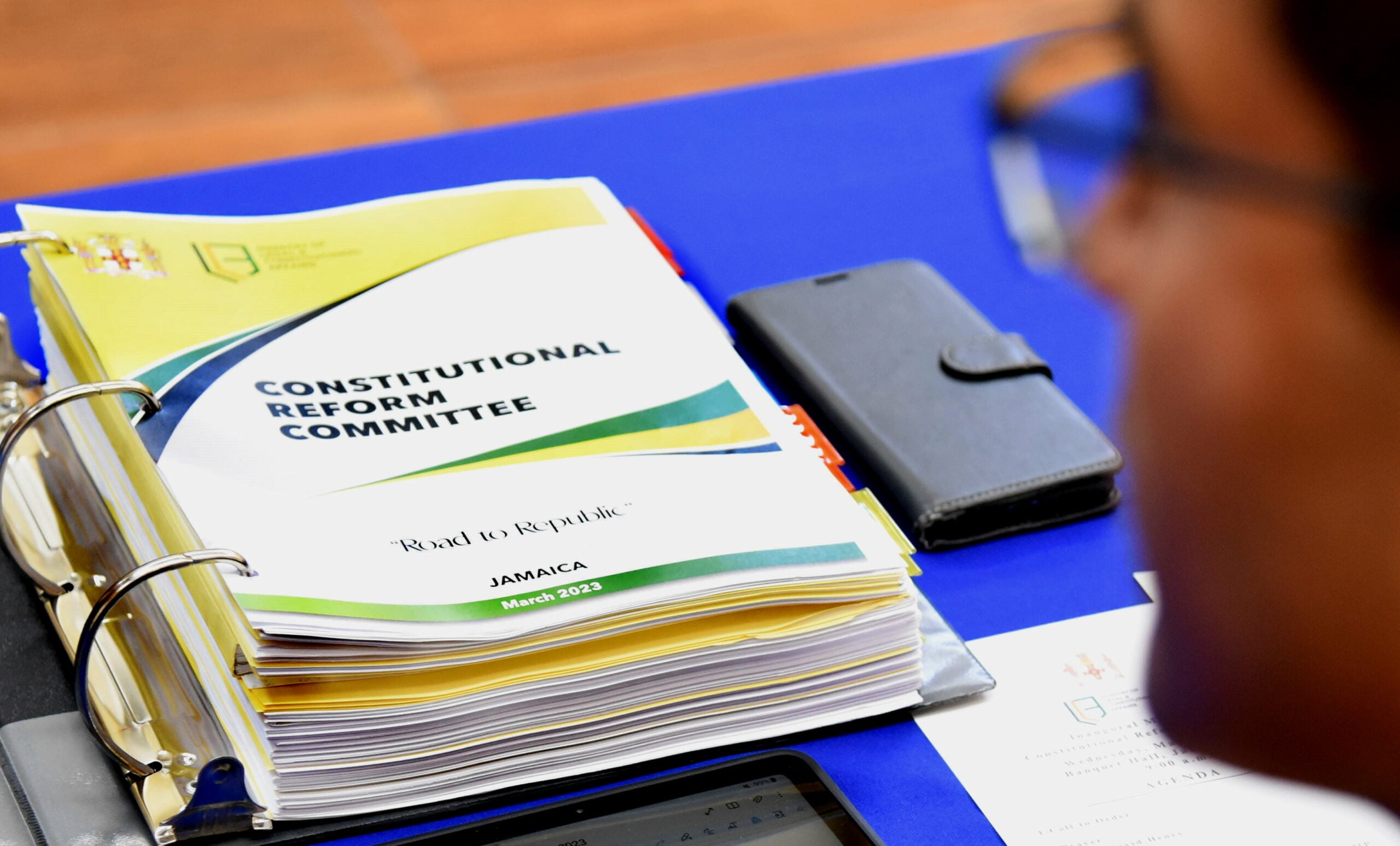
During the Throne Speech in February, opening the new parliamentary year in Jamaica, the Governor General indicated that constitutional reform remains a priority for the government. In December 2021, Prime Minister Andrew Holness expressed his desire to have the then monarch, Queen Elizabeth II, removed as Jamaica’s head of state by the country’s 60th anniversary of independence the following August. In January 2022, Jamaica’s Ministry of Legal and Constitutional Affairs was established to give form and purpose to the country’s republican aspirations. As a show of intent, a Constitutional Reform Committee (CRC) was later set up, comprising a wide cross-section of societal representatives to ensure broad-based input.
This effort received a further boost two months later, in March 2022, when the prime minister signaled Jamaica’s intentions to Prince William and Catherine, Princess of Wales, during their visit to Kingston, celebrating the Queen’s 70 years on the throne. Holness pointedly stated that Jamaica was prepared to “move on” from the monarchy. By the end of the next fiscal year, which the Throne Speech covers, Jamaica will be only months away from celebrating its 65th anniversary of independence. Charles III remains Jamaica’s head of state, having succeeded the Queen just six months after Holness’ declaration that Jamaica would soon transition to a republic.
Despite the delays and the apparent deadlock that attended the process during its first iteration, Jamaica could still meet this symbolic timeline if the effort is reinvigorated. However, that will only be possible if the government and the parliamentary opposition resume deliberations immediately, given the time constraints imposed by the legislative process. After being introduced as a bill in the House of Representatives, amendments to constitutional clauses require at least eight months—and up to a year—to pass through parliamentary debate before they can be put to a referendum. The removal of the monarch as Jamaica’s head of state is a deeply entrenched provision in the Constitution and therefore requires a plebiscite. By the time additional provisions are settled, Jamaica could realistically have the framework in place by August 2027.

Encouragingly, consensus has already been achieved on the question of removing the monarch. That position had been determined by a previous Constitutional Reform Committee in the mid-1990s and was reaffirmed by the most recent committee. The process stalled when the opposition insisted that the question of Jamaica’s final court of appeal be addressed simultaneously, arguing that full accession to the Caribbean Court of Justice should occur during the same stage of reform as the monarch’s removal. The government has maintained that the issue should be dealt with at a later stage. The opposition may fear that if the matter is not addressed simultaneously, the transition to the CCJ may never occur. The question of adopting the court has been on the national agenda since the early 1970s, yet tangible progress remains elusive.
The government must now move with greater urgency, not only on this issue but on the broader contours of constitutional reform. After the last elections in September 2025, the functions of the Constitutional Affairs Ministry were reintegrated into the Ministry of Justice. In the six months since, and in the absence of clear plans outlining a renewed constitutional reform agenda, the process appears stalled and in need of revitalization. Beyond the legal and political mechanics, meaningful constitutional reform offers an opportunity to deepen indigenous cultural expression and advance the broader project of decolonization in Jamaican society. The inaugural report of the CRC, published in 2024, argued that a reformed constitution should “be deeply grounded in the cultural fabric of the nation, ensuring that it resonates with and is accessible to all citizens,” while embodying “the unique identity, values and aspirations of Jamaica.”
Constitutional reform has historically been a contentious process in Jamaica. Less than a year after full emancipation was granted in 1838, the local planter class made an aborted attempt to suspend the Constitution, nearly precipitating a governance crisis. Three decades later, in the aftermath of the Morant Bay Rebellion, the local Assembly voted itself out of existence, and the island came under direct rule from Britain. Limited political representation returned two decades later, and further concessions for local participation followed during the first half of the twentieth century. After the granting of Universal Adult Suffrage in 1944, additional constitutional advances paved the way for independence, including the creation of the Cabinet as the primary instrument of policymaking and the achievement of full internal self-government. These developments were, without doubt, accompanied by intense debate.
No less should be expected today. Within the last three decades, the most significant update to the Constitution was the incorporation of the Charter of Fundamental Rights and Freedoms in 2011. That reform received bipartisan support, demonstrating the ability of legislators to unite around issues in the national interest. The same spirit of cooperation will be required again—this time with greater urgency.
The preference for a local head of state has long been established, although the method of selection remains unresolved. Repudiating the British Order in Council—the imperial instrument that contains Jamaica’s Constitution—has also been broadly agreed upon so that the country’s highest law can be repatriated to Parliament and become a fully Jamaican document.
However, several important issues remain unsettled. These include the size and composition of the Senate, reforms to Cabinet membership, and parliamentary changes such as recall procedures, impeachment mechanisms and fixed election dates. There is still considerable work to be done. Yet the opportunity exists to restart the process with renewed purpose. A reconstituted Constitutional Reform Committee should be convened as soon as possible to examine these matters and accelerate Jamaica’s progress toward republican status.
Keenan Falconer is an Economist with experience across Jamaica’s public and private sectors and the multilateral financing space. Send feedback to keenanjfalconer20@gmail.com.
 English (US) ·