
 1 week ago
9
Prime Minister John Briceño is leading a delegation to Bangkok, Thailand, and attending high level meetings with world leaders. In an exclusive interview with Love News, the Prime Minister says he has been engaged in multiple meetings discussing a wide range of issues ranging from energy to loan agreements and inflation. In the matters of fuel prices and inflation, he says these issues are being echoed by other country leaders as they attend the annual meetings of the World Bank and the International Monetary Fund.
John Briceño, Prime Minister of Belize: “I met Prime Minister Mottley and we were talking about it and she said she’s having the same problems. She’s having the same challenges. Belize now is in a better position than many of our colleagues in the Caribbean. Why? Because we have a thriving agricultural sector. You know, we grow our own beef or our own pork or our own chicken or eggs or own milk. Despite the fact that it still goes up, it does not go up as much as it is going up in these small Caribbean countries that all they have is tourism. And here we have all of these other opportunities. So last night at the dinner I was seated right opposite the managing director of the IMF, Georgina. And we had a nice discussion and again the challenges that we’re facing, the issue of inflation, the problem with fuel and diesel and so forth. And certainly the issue of inflation that continues to affect the entire world you know it is something that we are trying to find ways on how we can address that as a world community, that jointly we could find ways how to be able to see what we can do to hold down inflation because once inflation goes up it affects everyone and it affects everything from transportation to the economy, to electricity, to your cost of food, to agriculture, to tourism, to everything. Again, we’re working on that.”
For low-income households, those increases mean finding more money for everyday needs from an already tight budget. Briceño acknowledged that strain, expressing sympathy for people struggling to make ends meet. He said the global events driving those costs are beyond Belize’s control, but that there are several measures to mitigate the effects of inflation.
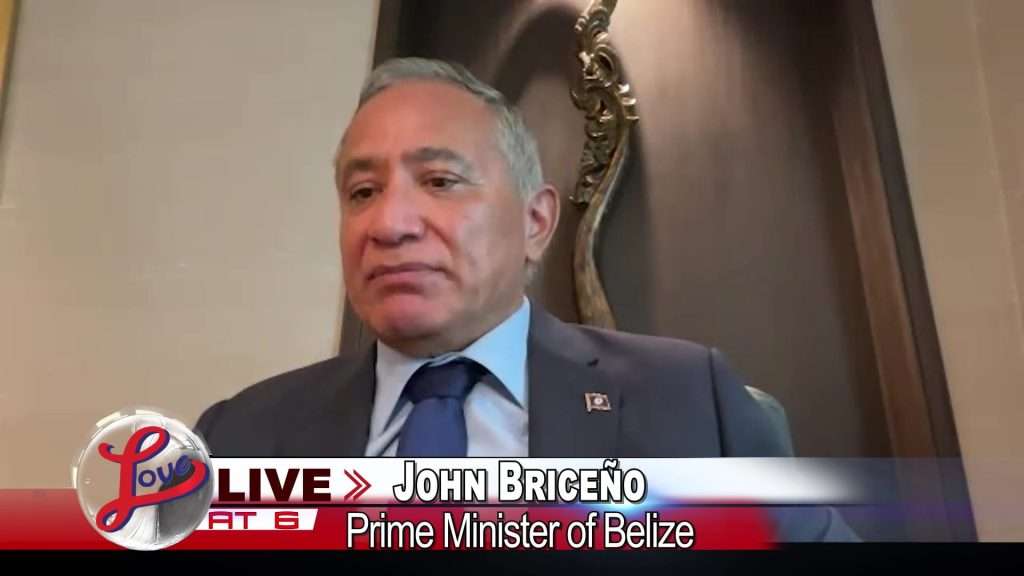
John Briceño, Prime Minister of Belize: “Every leader will tell you they have the same problem. And they’re trying to find ways, one, to explain to people, and two, to find ways so you could find some kind of relief. Now I cannot blame a worker that’s making $200, $300, $400 a week and going to the supermarket and seeing prices go up almost on a monthly basis. I couldn’t understand the frustration. Now, we all understand, especially as small countries like Belize, we import inflation. We have no control over that. We have no control over the price of diesel, for instance. A war was created between the United States and Iran and we have nothing to do with it. Nevertheless, we are facing the problems that it has created. And so what many countries, some of the bigger countries or the richer countries, they could afford to be able to give more financial relief in one way or the other. Countries like Belize it’s very difficult because if we cut from one, to be able to give this kind of relief, it has to come from somewhere, whatever relief has to come from somewhere. We have tried, when I explained to many of our leaders of what we’ve been doing, they look at it admirably because I said whilst we cannot control the cost of goods going up we try to find ways where we can alleviate challenges that our families meet on a daily basis, on a weekly basis. The National Health Insurance that have been rolled out, you know, you’re basically paying $2 for a doctor visit and the medicines that you pay it’s probably about 20% of the cost that you would get if you go to a private clinic. Education 80% of all high schools, sixth form, university students get some kind of relief from government. Increasing the threshold in PAYE to $29,000. That’s almost 3,000 more families are getting more monies in their pocket because they do not have to pay the income tax. And so we find different ways where we can be able to help to form some kind of relief that they’d be able to assist. We, for instance, with the bus people, we have committed to give a subsidy up to the end of December. And if at the end of December, the prices still have that gone down we will be able to then extend it up to the end of March. As it is right now, the cabinet is looking at some, Minister Fonseca gave us, you know, about 10 points. I’m having the Ministry of Finance look at it to see how much it would cost or what we can do to be able to continue to provide relief.”
Prime Minister also addressed Guatemala’s recent move to cut taxes on fuel. He said Belize has already given up fifty million dollars in revenue through its own fuel tax reductions. His comments follow Financial Secretary Joseph Waight’s explanation to Love News this week that government has absorbed about one dollar and thirty cents per gallon in fuel costs.
John Briceño, Prime Minister of Belize: “I remember when President Arevalo of Guatemala said that he was going to reduce the taxes on fuel and some Belizeans and some people in the media were getting all excited. We have been doing that from day one when that started to affect us and now he is finding himself in problem and going now to the Congress to say that they have to cut some of the social programs that they have because they’re not getting in the revenues from the taxes on fuel. We are not there despite the fact that we have cut down the taxes so far we have given up according to the financial secretary close to 50 million dollars in taxes. But even with all of that we’re still trying to keep up with the social programs that we have because I think that’s a centerpiece of Plan Belize 2.0.”
Reporter: That 50 million would be from the taxes that you take off the fuel ?
John Briceño, Prime Minister of Belize: “From the taxes from fuel yes, what we have given up so far.”
At a Caribbean Ministerial Meeting held alongside the annual meetings in Thailand, Briceño said government’s challenge is to provide relief while keeping public finances strong enough to respond to future shocks. The government issued a release today, and reported that Belize’s public debt had fallen to sixty-six-point four percent of gross domestic product in August, and that the country expects to maintain a primary surplus this year.
 English (US) ·