
 9 months ago
154
9 months ago
154
Around this time each year, conversations resurface lamenting the loss of Christmas traditions, particularly Jonkonnu. Too often, these reflections amount to little more than nostalgic fodder — a reminder that, long before Christmas became synonymous with imported carols and commercial spectacle, Jamaicans practised something deeply symbolic and rooted in ancestral memory. Loud, unpredictable and defiantly expressive, this masked tradition once defined the festive season for enslaved Africans and their descendants.
Today, far fewer Jamaicans can explain where Jonkonnu came from, what it meant, or why it matters beyond spectacle. That quiet fading is evident across several of our cultural traditions, as deeply meaningful practices are increasingly reduced to occasional performances, festival features, or historical references rather than lived traditions.
When this happens, the loss is rarely sudden. It is slow and often goes unnoticed. Traditions do not disappear because they are irrelevant; they disappear when their meanings are no longer understood, taught, or practised. In other words, when cultural pride has given way to indifference.
What Jonkonnu Was — And What It Meant
Jonkonnu also known as Jonkonnu, Junkanoo or John Canoe, is one of Jamaica’s oldest performance traditions, rooted firmly in the Christmas season. During slavery, Christmas Day, Boxing Day and New Year’s Day were among the few holidays allowed to enslaved Africans, creating a rare window for communal expression.
From its earliest records in the eighteenth century, Jonkonnu combined masquerade, music, dance and procession. Bands moved through towns and villages, accompanied by drums, fifes and rattling instruments, performing characters such as the King and Queen, Pitchy Patchy, Horse Head, Cow Head and Belly Woman. Masks concealed identity, speech was often whispered, and performance unfolded in public space.
Scholars have long noted that Jonkonnu emerged from layered influences. African masquerade traditions, with their emphasis on masking, ritual movement and communal meaning, were central. At the same time, many Africans brought to the Caribbean had already been shaped by Afro-Iberian Christian cultures, where festive processions, kingship symbolism and Christmas rituals were familiar. These forms were further transformed under Caribbean slavery, creating something neither purely African nor European, but distinctly Afro-Caribbean.
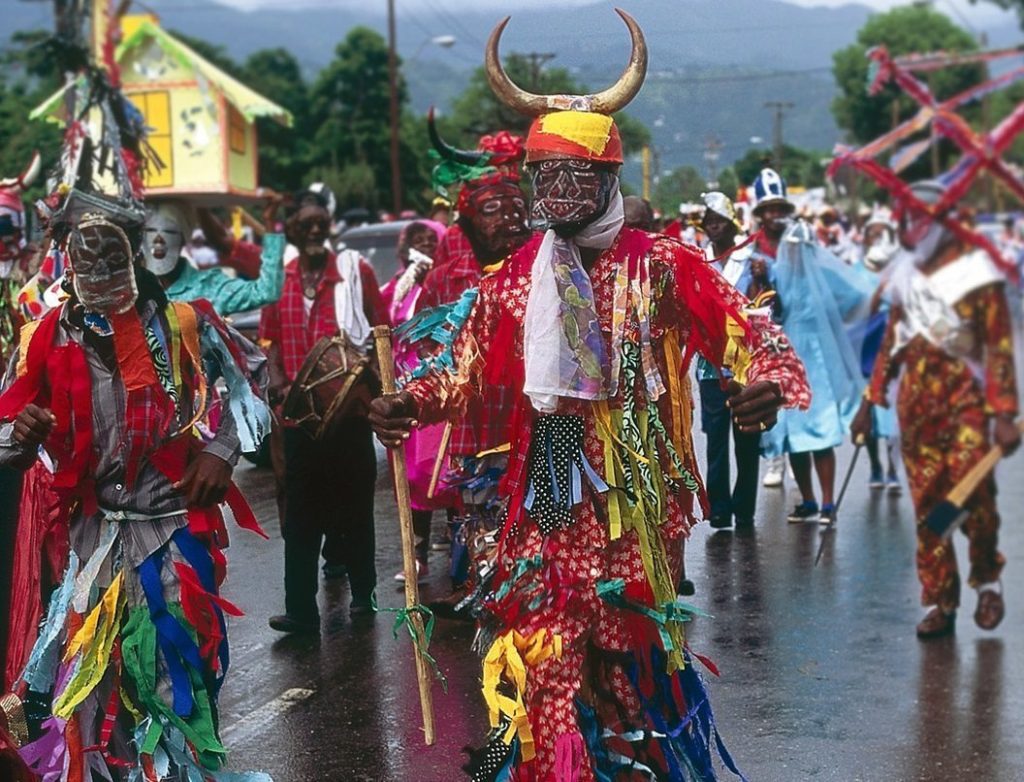
Slow Dilution and Fading of A Potent Tradition
For enslaved Africans, Jonkonnu was far more than entertainment. It offered a rare space for autonomy, creativity and expression in a society designed to deny all three. Christmas provided the ritual container, but the performances themselves allowed for the inversion of hierarchy, satire, movement through public space and communal affirmation. This is precisely why Jankanoo unsettled colonial authorities and missionaries.
After Emancipation, missionary influence, civic restrictions and outright bans further weakened the tradition, particularly following incidents such as the 1841 John Canoe disturbances in Kingston. Jonkonnu was increasingly labelled as pagan and unruly. Over time, economic pressures, changing entertainment tastes and the rising cost of costumes and instruments made participation even more difficult.
What survives of this potent cultural expression is often diluted and stripped of much of its original meaning, appearing mainly in rural pockets, small bands or through organised cultural events rather than as an everyday community practice. Unsurprisingly, piecemeal institutional efforts to revive the tradition have struggled to reverse the tide, and while they have achieved occasional performance visibility, have not secured long-term continuity.
Preservation Requires More Than Display
Since 2022, cultural agencies have spoken more openly about reviving traditional forms, and these efforts are welcome. When traditions are reduced to staged performances for audiences, their deeper meanings are easily lost. Preservation begins with knowledge and intentional community practice, not spectacle staged primarily for tourists. While museums, festivals and history books play a vital role, they represent only a small part of how cultural identity is sustained through tradition.
This is not about freezing traditions in time. Cultural practices evolve, and they must be allowed to do so. What matters is that evolution remains rooted in history and ancestral meaning rather than severed from it. Teaching young people the stories behind the masks, the significance of the characters, and the historical role of Christmas as a time of communal expression allows traditions like Jonkonnu to live on generation after generation.
Choosing Continuity
Jonkonnu is not a relic. It is a cultural inheritance that requires care, decline is not inevitable, nor is its preservation the responsibility of cultural institutions alone. It depends on whether communities value understanding as much as performance, and teaching as much as celebration.
Cultural loss rarely announces itself loudly. It happens through neglect, misunderstanding and silence. What we choose to explain, practise and pass on will determine whether traditions like Jonkonnu remain part of our living culture or fade quietly into memory.
Making space for our cultural traditions — officially and publicly — is not nostalgia. It is cultural stewardship.
 English (US) ·