
 5 months ago
83
5 months ago
83
There is a pattern that plays out repeatedly in the history of technology. An external player, operating from a position of scale and infrastructure that regional incumbents cannot match, enters a market that local institutions have left underserved. By the time the incumbents respond, the customer relationship has already moved. The Caribbean financial ecosystem is approaching one of those moments.
XMoney, the payments platform launched by Elon Musk’s X (formerly Twitter), is designed as a financial payments platform enabling peer-to-peer transactions, similar to services such as PayPal, Venmo, or Zelle. In January 2025, X announced a partnership with Visa supporting the launch of a digital wallet and peer-to-peer payments service. The X Money account, powered by Visa Direct, allows instant funding of X Wallets, seamless P2P payments through connected debit cards, and the ability to transfer funds directly to bank accounts (The Paypers, 2025a). The platform has since gone into beta, with early users showing off an exclusive metal card offering 6% APY and 3% cashback on purchases, signalling that X is stepping its services up to a full financial super-app (ALM Corp, 2026).
This is not a payment product with a side of social media. This is a deliberate play for the “everything app” model.
The Super-App Precedent
One app, one sign-in, one user experience for virtually any product or service a customer may want or need. It is not unusual for a WeChat user in China to set up a date with a friend via instant messaging, make dinner reservations, book movie tickets, order a taxi, and pay for every transaction along the way, all using one single app (KPMG, 2019). That model has already demonstrated its disruptive capacity in financial services. The super apps market is estimated at USD 127.1 billion in 2025 and is projected to reach USD 861.9 billion by 2035, at a compound annual growth rate of 21.1% (Future Market Insights, 2025). Super apps are disintermediating banks from their customers, using social media and transactional data to risk-assess loan applicants, and targeting financial products to customers at the exact time they need them (KPMG, 2019). Traditional banks, with their siloed data and legacy infrastructure, are already struggling to keep pace.
PayPal signalled this shift early. Its executives promised to build a mobile app that would allow consumers to shop at millions of merchants while also accomplishing most of what they currently do at banks (Payments Dive, 2025). The core insight from that announcement holds regardless of how the execution played out: platforms that already hold consumer attention and trust are better positioned to own the payment relationship than institutions waiting for customers to come to them.
X has something PayPal never had: a social platform with hundreds of millions of active users who already express sentiment, transact culturally, and build community on the platform. Visa’s CEO Ryan McInerney confirmed that XMoney “will allow the 600 million or so active monthly users of X to fund their X Money accounts,” transfer funds back to their bank accounts instantly, and enable creators on the platform “to get paid much faster when they use Visa Direct” (Fortune, 2025).
The Caribbean User Base Is Already There
The conversation about XMoney and the Caribbean cannot start without acknowledging that X users across the region are not hypothetical. According to the World Population Review 2026 report, X had approximately 1.89 million users across the Caribbean (World Population Review, 2026). The top three countries are Dominican Republic with 679k users, Jamaica 328k users, and Trinidad and Tobago with 155k users, and it does not capture users who access the platform using VPNs. The real footprint could be much larger.
What is particularly significant about that user base is its composition. Jamaica and the wider Caribbean sit at an unusual intersection: a population that includes both the unbanked and the digitally sophisticated, existing side by side on the same platform. There are still more than 200 million unbanked individuals in the Latin America and Caribbean region, and close to 50 million small merchants trying to get access to digital payments and banking (Inter-American Dialogue, n.d.). Meanwhile, a growing class of online earners, which includes influencers, content creators, short-term rental hosts, and digital service providers, already rely on global platforms to receive income, often holding funds in digital wallets before repatriating them.
This is money that passes through intermediary systems before it touches the local economy, and in many cases, it never fully does.
The Infrastructure Gap That XMoney Exploits
The persistent frustration of moving money across CARICOM has been documented for years and remains largely unresolved. The G20 Roadmap for Enhancing Cross-Border Payments identified four long-standing frictions in the market: high costs, low speed, limited access, and insufficient transparency (Atlantic Council, 2025). Retail remittances to the Caribbean still carry an average sending cost of 7.1%, one of the highest sub-regional rates in all of Latin America and the Caribbean (RemitSCOPE, 2025). Within the Caribbean, the situation is compounded by fragmented banking infrastructure, limited interoperability between island financial systems, and a regulatory environment that has historically moved more slowly than the technology it governs.
It is worth noting that some Caribbean founders are already attempting to close this gap by building global solutions in more robust startup environments. Sendana, founded by Monique Powell and backed by DraperU Ventures and the Stellar Development Foundation, is building a global banking and money transfer platform designed specifically to serve emerging markets across the global South (Silicon Caribe, 2025). Through Sendana, freelancers, remote workers, and content creators can open a USD account in minutes using only a local ID, receive payments from platforms like PayPal, Amazon, YouTube, and Upwork, and send money to over 20 Caribbean countries (Sendana, n.d.).
Powell’s framing of the problem is direct and worth quoting at length:
“Sendana was built for the over 40 million freelancers, remote workers, content creators, and countless small businesses across the Global South that still struggle to get paid from overseas and sometimes miss out on opportunities because of this. Historically, global payment platforms like PayPal have neglected many of the countries in these regions. Even if XMoney goes against that grain and decides to serve them, it is important to understand these freelancers, creators, and remote workers are now considered the world’s fastest-growing workforce, so the opportunity for multiple players to serve them from different angles will continue to expand exponentially.”
-Monique Powell, Founder, Sendana (personal communication, April 27, 2026)
That observation reframes the XMoney arrival in an important way. The arrival of a well-capitalised external player is not the end of the story for regional fintech. It is a signal of how large the underserved market has become. Powell adds that competitive parity at the product level is not the core concern: “There is nothing, feature-wise, that XMoney offers that has not already been built into Sendana or on our roadmap. Players like us also understand the emerging and developing market dynamic first-hand, which I see as an advantage.”
That advantage is real, but in this fast-paced world, we know things can change rapidly. Founders like Powell know that understanding a market and having the distribution and capital to dominate it are different things. XMoney does not need to understand all the nuances of the Caribbean, but if it is convenient enough and trusted enough, it can change the game significantly, and the same goes for Sendana and other players.
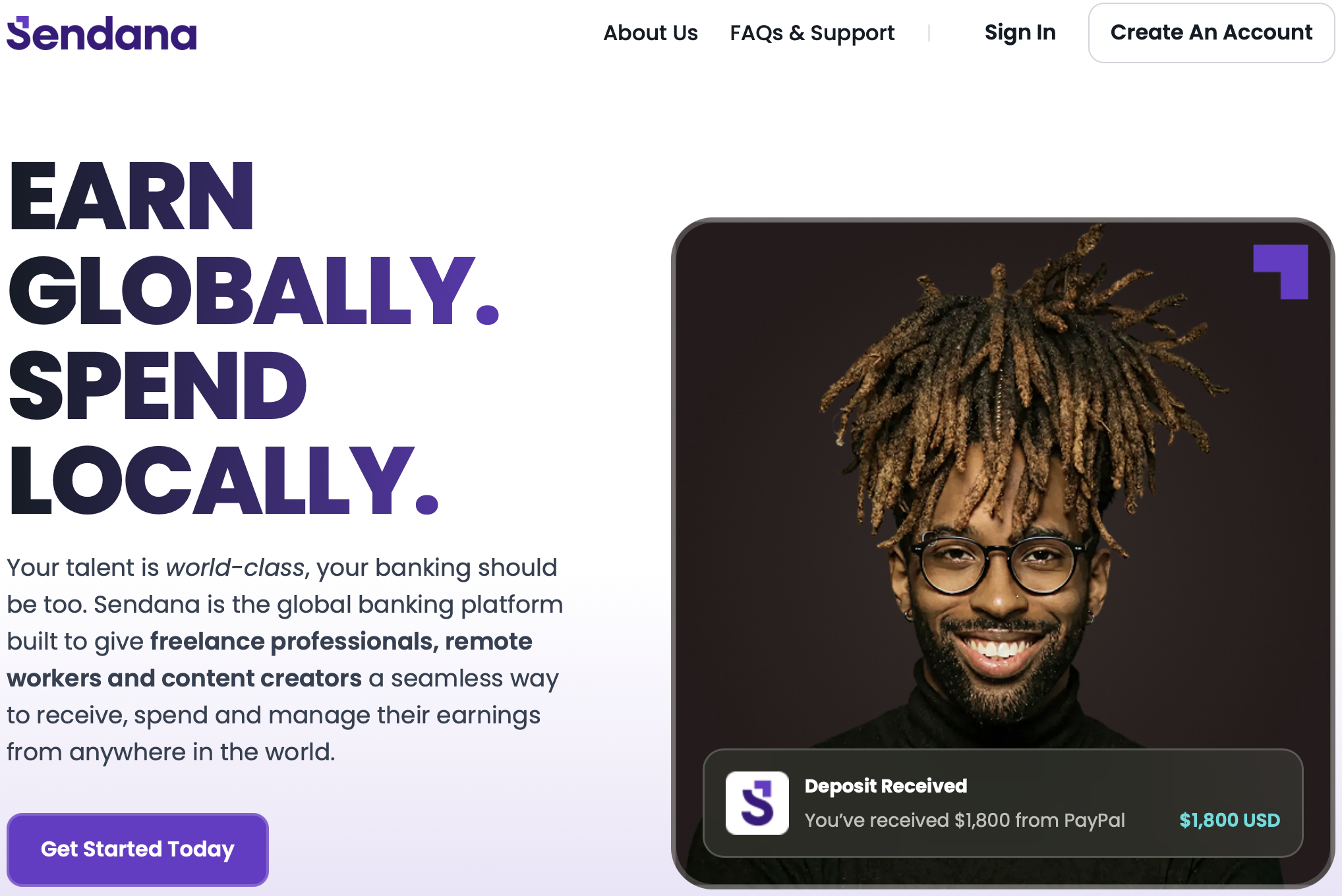 Image Source: https://www.usesendana.com
The Revenue Question for Local Financial Institutions
If we do a deep dive into the regional capital markets and look at the Caribbean stock exchanges, we know they are heavily weighted toward financial sector listings. Banks and financial holding companies represent a significant share of publicly traded market capitalisation across Jamaica, Trinidad and Tobago, and Barbados. Their revenues are driven by net interest income from loans, transaction fees, and foreign exchange spreads.
XMoney, and the super-app model more broadly, has the potential to compress each of these revenue lines over time. Currently, the vast majority of payments on super-app platforms flow through traditional banking and card issuer infrastructure. However, the bigger super apps have strong relationships with banking arms that are using the super app’s brand reputation and reach to access new customers (KPMG, 2019). The risk is not that banks disappear from the transaction. The risk is that they become invisible to the customer, reduced to infrastructure, while the consumer relationship migrates to the platform.
Banks will need to decide whether they plan to be a front-office player within a super app, a back-office enabler, or simply a piece of regulated infrastructure, and then start investing and evolving toward achieving that vision (KPMG, 2019). For Caribbean financial institutions, the same question applies, but with less time and fewer resources to answer it.
What the Creator and Sharing Economy Reveals
A concrete example of the leakage problem already playing out is visible in how online earners manage their income. YouTube creators, Airbnb hosts, TikTok monetisation recipients, and Upwork freelancers across the region often receive income in USD through global platforms. That money enters PayPal, Payoneer, or platform-specific wallets. Some of it is repatriated to local bank accounts. But a meaningful share remains in digital form, circulating through online purchases, subscriptions, and other digital-first transactions, without ever being formally counted as part of the domestic money supply.
This represents both a data gap and a policy gap. Regulators and financial institutions do not have full visibility into the volume of digitally held income. Without that visibility, it is difficult to design products that meet these earners where they are. Sendana’s architecture is a direct response to this reality: users can open a USD account using only a local ID, receive payments from platforms like PayPal, Amazon, YouTube, and Upwork, and send money across 20 Caribbean countries (Sendana, n.d.). XMoney, attached to the same platform where much of this creator economy conversation happens, would create a direct competing channel for that income, flowing into a wallet tied to an X handle, accessible via a Visa card, without requiring a traditional bank account at all.
The Regulatory Gap: What Needs to Change
The infrastructure problem has a regulatory dimension that is equally important, and here Powell’s perspective is instructive. Asked what she would tell the heads of the Bank of Jamaica, the Central Bank of Trinidad and Tobago, and CARICOM’s payments working group if she had thirty minutes with them, Powell pointed to fragmentation as the critical obstacle.
“Some CARICOM countries are doing more to drive fintech innovation than others. Barbados, for example, seems to be heading in the right direction in terms of gradually removing some of the barriers that have typically stood in the way of startups looking to bring fintech products to market. Some are not quite as progressive. Those I would encourage to look around the world at countries that have benefitted from fostering the growth of fintech startups, to see what they can take away or adopt, while adjusting for local realities.”
– Monique Powell, Founder, Sendana (personal communication, April 27, 2026)
Her proposal is concrete and structural. Powell advocates for what she describes as a compliance passport for fintech players operating across the region: one overarching set of regulatory requirements that, once met in one CARICOM country, does not have to be repeated in full for each additional territory. In her words: “This would prevent the need for fintechs that meet those requirements in one CARICOM country from having to redo the usually lengthy process every time they seek to put down roots in a new Caribbean country.”
This is not a novel idea in global fintech policy. Mutual recognition frameworks exist in the EU and have been explored in Southeast Asia precisely because fragmented compliance creates a structural disadvantage for smaller regional players relative to large global platforms that can absorb regulatory costs at scale. XMoney does not face a CARICOM compliance maze. Regional fintechs do. That asymmetry matters.
The Call to Action
Disruption does not wait for incumbents to finish their strategy sessions. The lesson from WeChat, from M-Pesa in East Africa, and from the rapid growth of digital remittance platforms across the LAC corridor is that financial behaviour changes when a better, simpler option arrives. Remitly grew from 14% to nearly 23% market share in the US-LAC remittance corridor by 2024 (Inter-American Dialogue, 2025), not because it lobbied regulators, but because it offered a product people actually wanted to use.
The Caribbean has the talent, the urgency, and enough data on its own problems to build better solutions. Sendana is proof of that. But building regionally is harder, slower, and more constrained by capital than building from Silicon Valley with Visa as your first partner. The compliance passport Powell describes would not solve everything, but it would remove one of the most concrete structural barriers slowing regional fintech from reaching the scale it needs.
Local players need to fix the underlying infrastructure. Regulators need to think outside conventional frameworks and engage proactively with what financial inclusion looks like in an era of super-apps. Consumers need to continue demanding more.
And policymakers need to understand something clearly: every month that the compliance maze remains intact is a month that regional fintechs spend on paperwork instead of product, while XMoney scales.
The best time to act was before XMoney launched. The second-best time is now.
About Dataffluent
Dataffluent is a Techstars-backed data science and analytics company headquartered in Kingston, Jamaica. We build data products and analytical solutions that help financial institutions, investors, and businesses across underserved emerging markets move from raw data to decisions that drive measurable results. Our flagship product is a financial analyst platform purpose-built for the Caribbean capital markets. The platform delivers fundamental analysis of publicly traded companies across the region, combining machine learning-driven sentiment analysis, and macroeconomic predictions covering inflation, interest rates, and foreign exchange movements. For analysts, portfolio managers, and institutional investors operating in markets where reliable, region-specific intelligence has historically been hard to come by, this fills a critical gap. We understand the market we operate in. Fragmented data environments, thin public disclosure requirements, and the unique macroeconomic dynamics of small open economies are not edge cases for us. They are the conditions our models are trained on, and our platform is built for. Join our beta waitlist or book a demo to learn more.
 English (US) ·