
 9 months ago
95
9 months ago
95
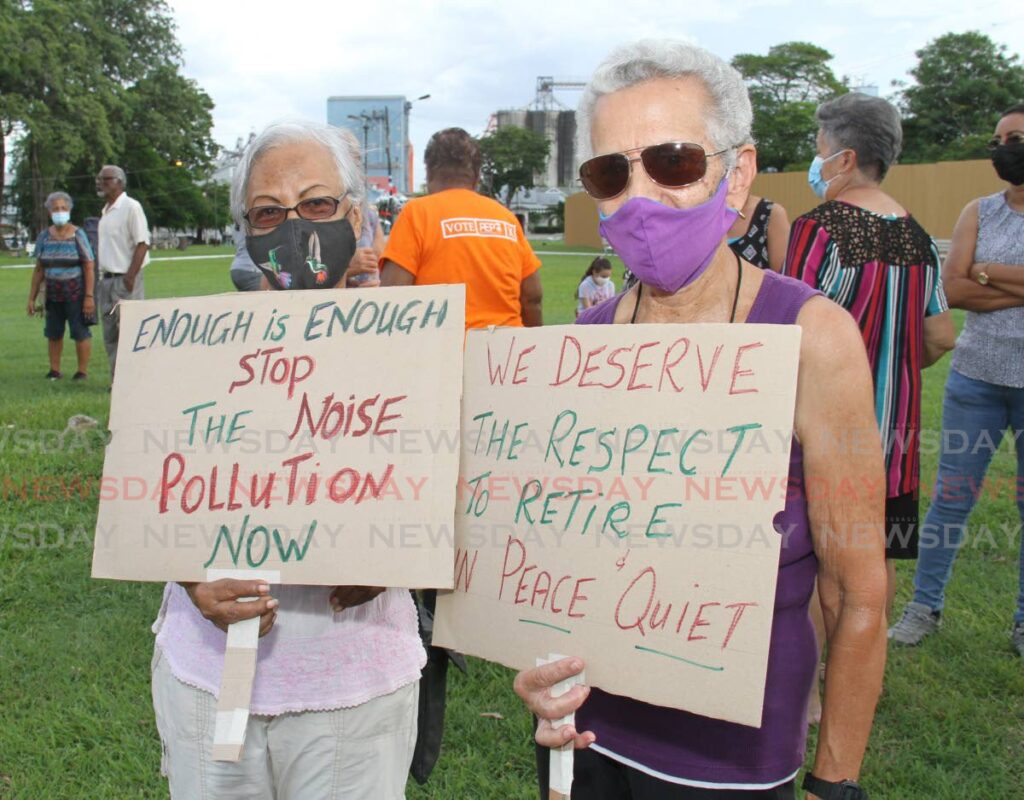 Fed up of the noise from entertainment nightspots in the area, these Woodbrook residents came out with their placards to express their disgust. - File photo by Ayanna Kinsale
 Under its former board, the Environmental Management Authority (EMA) claimed a two per cent drop in the number of noise complaints it had received since last year, and a 16 per cent drop in complaints to the police.
However, anti-noise NGO, Citizens Against Noise Pollution in TT (CANPTT), argued that the figure was not telling the full story, as people were now suffering from complaint fatigue as they considered the EMA had not been taking their concerns and reports seriously.
The EMA report 2024 said, "In 2024, the total number of noise complaints received through the complaints hotline that fell within the remit of the EMA was 152. This represents a decrease of two per cent when compared to 2023."
The report said the EMA received a total of 464 noise complaints.
"A total of 312 of these complaints were referred to the TTPS for investigation, as they did not fall within the remit of the EMA.
"According to the TTPS, the total number of noise complaints received in 2024 decreased by 16 per cent from 7,484 in 2023 to 6,287 in 2024."
The EMA detailed the complaints it had received:
Loud music from bars (72); loud music from residential areas (314); loud music from events (14); noise from industrial activities/equipment (12); noise from establishments (27); and variation breaches (25).
The report also detailed the complaints specifically received by the EMA hotline, which noted a stark difference in the complaints received by any means by the listed hotline complained about loud music (residential), as only two complaints were received.
The report said the EMA handles a wide variety of noise complaints under the Noise Complaints Pollution Regulations (NCPR) 2001, but several activities were exempted from the legislation.
These were religious events and sporting activities without the use of sound amplifying equipment; educational instruction in schools; public marches, meetings, processions and gatherings under the Summary Offences Act.
Any alarm, emergency device, apparatus or equipment if triggered by an emergency; sound due to the installation, repair or replacement of public utilities in a public place; emergency work; warning devices; armed forces activities; motor-operated garden equipment such as lawn mowers, brush cutters, edge trimmers, mist-blowers, leaf-blowers and power tools at 7am-7pm; construction activity from 7am-7pm; agricultural machinery/equipment; and testing of emergency alarms, devices and equipment from 8 am-4 pm.
CANPTT vice president Lindy-Ann Bachoo challenged the EMA's claim of falling noise complaints from 2023 to 2024, including an alleged 16 per cent decrease in noise complaints to the TTPS.
"Taken at face value, this framing suggests progress. This is deceptive because it encourages the public to believe that noise pollution has improved, when a drop in reports can easily reflect reporting failure, not reduced harm," Bachoo said.
CANPTT again said claims of reduced complaints were deeply misleading.
"Many citizens have complaint fatigue. When citizens repeatedly report, follow up, and see no meaningful intervention, many eventually stop reporting altogether – because the process feels pointless."
Further, CANPTT lamented challenges in reporting.
"There is a lack of clarity in reporting and receiving help, as many complaints to the TTPS are referred to the EMA, and the EMA declares this is the remit of the TTPS, especially for residential noise.
"The EMA has no after-hours hotline numbers, and their cadre of officers is small, as of 2025, reportedly eight."
CANPTT said the TTPS also viewed such reports as non-emergencies and, coupled with a lack of sensitisation efforts, police widely ignore acting on such reports.
"People have quite literally stopped reporting because they have lost faith in the institutions that are supposed to protect them. Therefore, a decline in reports does not equate to a decline in harm.
CANPTT said this loss of confidence was further compounded by a surge in "threats and intimidation" experienced by residents who have attempted to report excessive noise.
"When complaints fall on the deaf ears of protective services, reporting becomes a personal risk rather than a safeguard. In that context, silence is self-preservation."
 English (US) ·